

By Sarah Hodges
Setting Sail for the Sacred
Note from the Director: Enjoy this month’s story of an exciting 3-person sailing canoe expedition as told by Sarah Hodges!
On one afternoon in August, I listened with excitement as a joyful commotion of sailing canoes, boats and salty smiles arrived on the water behind my backyard on Oahu. I could feel the sense of a humming sacredness, and the kind of camaraderie and teamwork that we always long for amongst a sizable group. Something special was taking place.
“People are having more powerful experiences than I ever dreamed was possible,” Nick Beck has since told Renée and me.
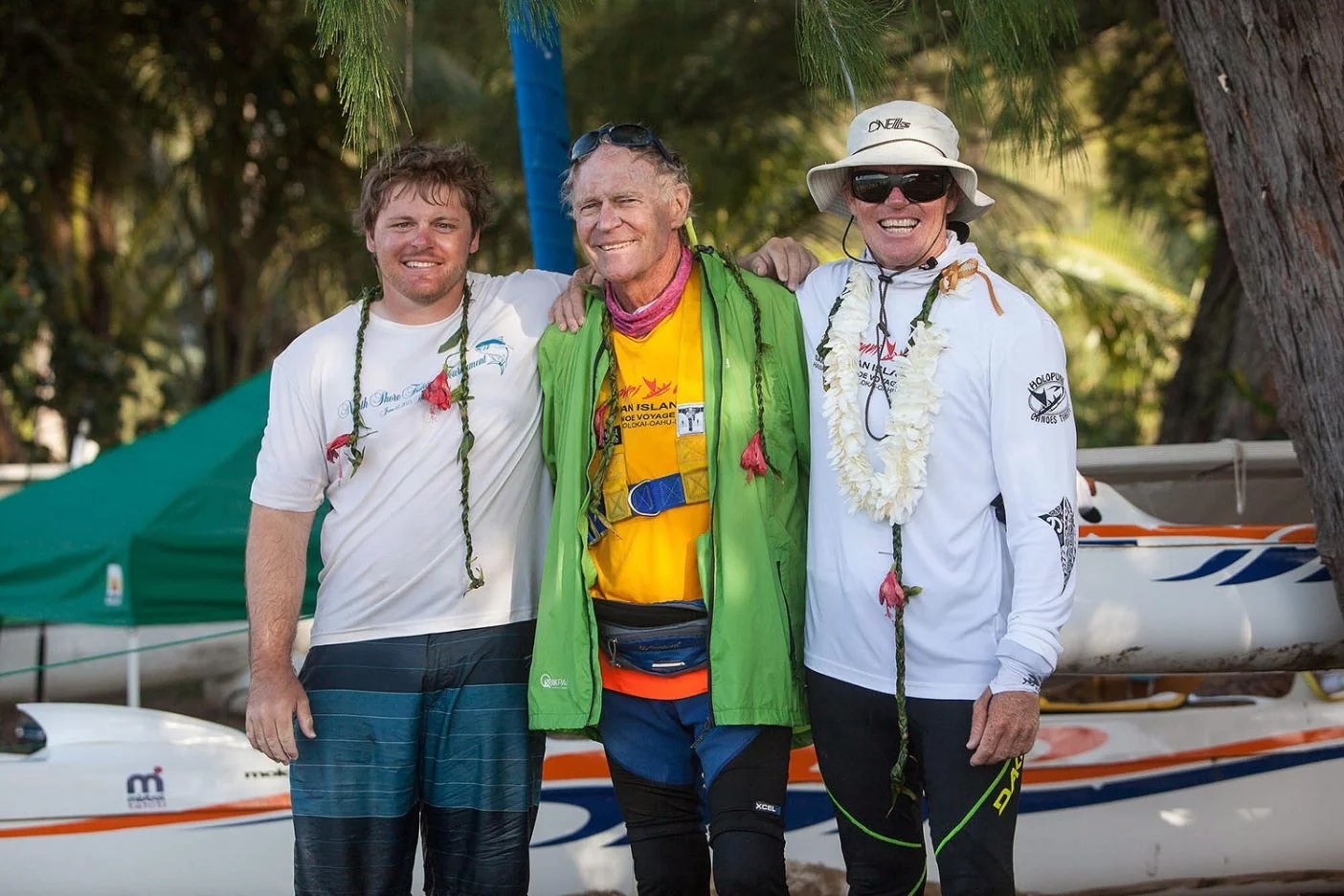
Creator of Holopuni canoes, Nick has found a way to share his sense of the sacred with his love of canoe sailing. He made his most recent voyage with a large extended ‘ohana (family) from across the Polynesian island chain and abroad. Their journey featured a rare and significant event on the venerated island of Kaho’olawe – “waypoint to the South Pacific”.
Nick’s original journey began when he made plans to revisit ancient sites that he had seen as a child on the Hawaiian islands. After his studies in archeology at the University of Hawai’i, he decided to approach these sacred and sometimes remote locations by canoe, just like the ancient Hawaiians did.
Nick set out to build a canoe that was sturdy enough to travel solo. He modeled it after the traditional Hawaiian sailing canoes, with an ama (outrigger) plus sails. When the boat was ready, in 1981, Nick took a year off work and began visiting locations across the island chain. “I started at the south point at Kalae off the Big Island, and from there made my way back to all the islands,” says Nick.
He was both awed and saddened by what he saw. Some sites were untouched and alive with mana (spirit), while many other locations were paved over or covered by golf courses and modern infrastructure. He had planned to write an extensive article about this one year mission. However, by the time Nick completed his route, he decided against putting some of these unsung locations on the loudspeaker, only to have them trampled by an influx of tours and sightseers. He walked away from the potential National Geographic article.
Instead, a seed arose from his trip. This seed has eventually grown over the decades into what is today the Holopuni International Sailing Canoe Association, with extensive life experiences and learning opportunities.
As time went on, word of Nick’s 3-person sailing canoe spread. Family, friends, neighbors alike were curious about his creation. Based on traditional native Hawaiian sailing vessels, his boats brought something of the modern to the ancient. The first few he made mostly for his own family members, then friends began asking.
The design underwent continual development. They had to be stable enough to cross all the channels in some very challenging conditions. Eventually, Nick sent the production to Pacific Offshore Rigging. His friend there told him, “Nick, eventually you’re going to have to charge people for these boats.” Needless to say, however, this entire endeavor has arisen and continues as an act of pure joy, a sharing of love.
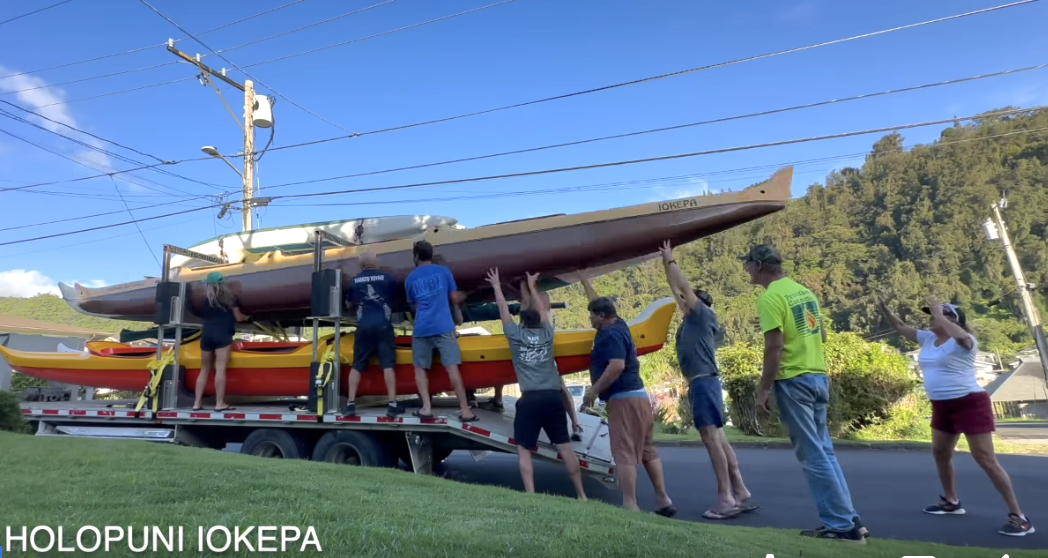
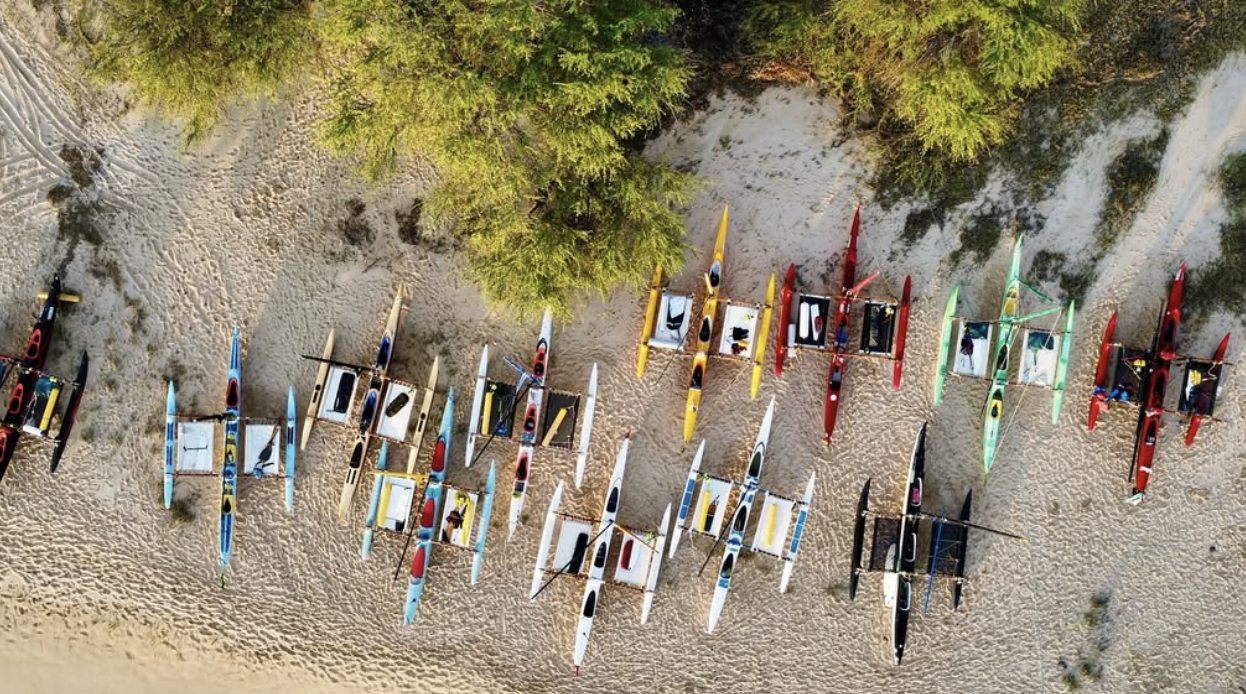
Now, over 100 Holopuni canoes exist around the world. Nick’s entire purpose for these is to promote the joy of sailing in a traditional (yet modernized) craft. Across Hawaii, Aotearoa, and Tahiti, Nick’s nautical creations sail like messengers from the past.
Nick’s mission is not complete without educational and community-building components. His organization now helps to guide Hawaiian youth in developing navigation and sailing skills. “Word is spreading,” says Nick. “Now, some elementary school students have grown up on the canoes and are sailing them with us as adults!”
Most recently, Nick and his organization brought together a diverse group of adults and youth for The Holopuni International Hawaiian Sailing Voyage, August 13 – 25, 2025. With 14 canoes, 4 escort boats, and dozens of crew members from across the Polynesian islands, New Zealand, Australia, and Continental USA, the success of the trip relied on collective preparation and teamwork.
“This trip was not a race, it was a voyage. Its purpose, to go and see, to share what we’ve learned and learn from others,” Nick explains.
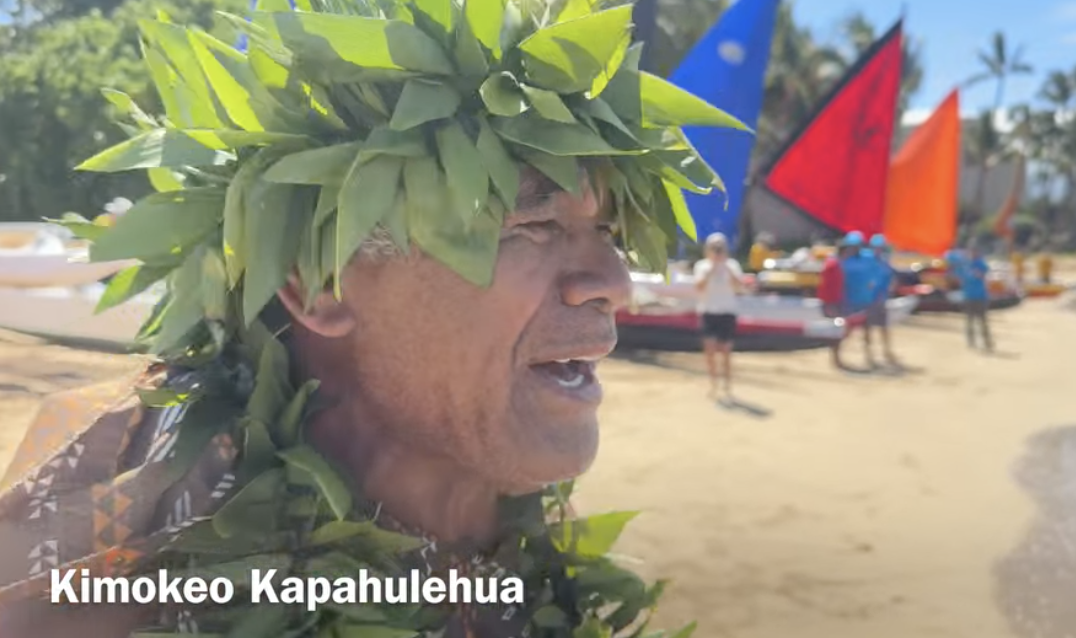
On the shore of Kihei, Maui, crewmembers gathered to initially rig their wa’a (canoes). Everyone circled up with bowed heads, listening as an opening oli (Hawaiian chant) by their host, Kimokeo Kapahulehua, reverberated in the early morning air. A hush of sanctity, palpable to all members, opened the way for this 12-day journey.
From Kihei, the group sailed first to Kaho’olawe, an island that few get the opportunity to visit. Special permissions and preparations allowed rare entry onto this island which was once the central location for celestial navigation, and then became an unfortunate bombing test ground for the US military.
“We were extremely lucky to set foot on this island,” Nick describes.
The last time he had been there was in 1981 when the US Navy still had possession of it. He had participated in the ongoing activism to stop the catastrophic damage that was happening. He was now about to participate in its healing.
Nick requested that each sailor bring from their homeland a rock or stone that carries personal, cultural, or ancestral significance – a request from the stewards of Protect Kaho’olawe ʻOhana when Nick asked what his group could bring.
These rocks or pohaku, were offered to the site where a heiau (ancient temple) is being rebuilt. Having pohaku from other islands in the Polynesian chain is particularly significant, as a symbol of the unification of all these Pacific islands.
Participants arrived on Kaho’olawe, each holding their stone to offer to the land.
One stone in particular stood out — a special quartz crystal from Norway – home of another seafaring people, ancestors of one of the Holopuni voyagers. Historically used by Vikings, this type of flat-shaped crystal helped seafarers locate the sun through thick fog. By holding the disc up to the sky suddenly they could see the bright shining circle of the sun. Voyaging brings the world’s people together.
Each participant came forward, recounting their story to everyone in the ceremony. Before departing Kaho’olawe, they participated in restoration work and offered their mana to the land. Nick tells, “At the end of the trip, so many people said this was the highlight of their experience.”
The route included Maui, to Kaho’olawe, to Molokai, Oahu and finally, Kauai. Participants experienced a sense of group cooperation and camaraderie they’d never felt before. During the ending ceremony on Kauai, Nick opened up the ‘floor’ for people to share about what they had just experienced. “We stayed there for another hour at least,” laughs Nick. “People’s lives are changing!”
Photos courtesy of Holopuni Association & Participants





Renée Tillotson
Renée Tillotson, Director, founded Still & Moving Center to share mindful movement arts from around the globe. Her inspiration comes from the Joy and moving meditation she experiences in the practice of Nia, and from the lifelong learning she’s gained at the Institute of World Culture in Santa Barbara, California. Engaged in a life-long spiritual quest, Renée assembles the Still & Moving Center Almanac each year, filled with inspirational quotes by everyone from the Dalai Lama to Dolly Parton. Still & Moving Center aspires to serve the community, support the Earth and its creatures, and always be filled with laughter and friendship!
Get the Still & Moving App
This post is also available in: English (英語)